


UK SME leaders seeking to scale operations without expanding domestic payroll overheads can manage South African remote employees seamlessly by aligning daily workflows, setting clear performance deliverables, and leveraging shared working hours. Operating on GMT+2, South Africa provides near-total workday overlap, allowing UK managers to integrate high-calibre, English-fluent professionals into daily operations while maintaining full management oversight and performance accountability.
How do UK managers manage South African remote staff effectively?
Managing remote staff across international borders requires transitioning from presence-based monitoring to structured, output-focused management. When UK organisations hire South African remote staff, managers encounter an experienced talent pool that operates within commercial, legal, and financial frameworks closely aligned with British traditions.
Effective remote team management rests on three core management principles:
- Direct Line Management and Integration: Remote hires should be treated as core operational team members rather than an isolated external support desk. Assign clear reporting lines to a designated UK manager and include remote staff in team meetings, strategic catch-ups, and operational planning.
- Leveraging Working-Hour Alignment: South Africa operates on GMT+2 throughout the year. During British Summer Time (BST), South Africa is just one hour ahead of the UK, and during Greenwich Mean Time (GMT), it is two hours ahead. This minimal offset allows UK decision-makers to schedule live video briefings, manage active Slack or Microsoft Teams channels, and collaborate in real time during standard UK business hours.
- Outcome-Based Accountability: High-performing professionals perform best when given autonomy paired with clear expectations. Define explicit project milestones, deliverable deadlines, and quality standards rather than monitoring hourly activity logs.
According to September 2026 workforce research from the Chartered Institute of Personnel and Development (CIPD), UK businesses navigating domestic cost pressures increasingly rely on international remote recruitment to secure critical skills without sacrificing management oversight. Expanding talent acquisition into South Africa offers immediate access to tertiary-qualified talent, where 74.2% of candidates hold NQF Level 5+ qualifications (RecruitMyMom Working Women in South Africa Report 2026).
For a broader introduction to structuring cross-border hiring, read our foundational Remote Hiring Guide for UK Employers.
What communication routines and tools optimize cross-border workflow?
Communication friction is the primary cause of remote team inefficiency. Because offshore remote hiring South Africa offers real-time collaboration advantages, establishing structured communication channels ensures seamless daily execution.
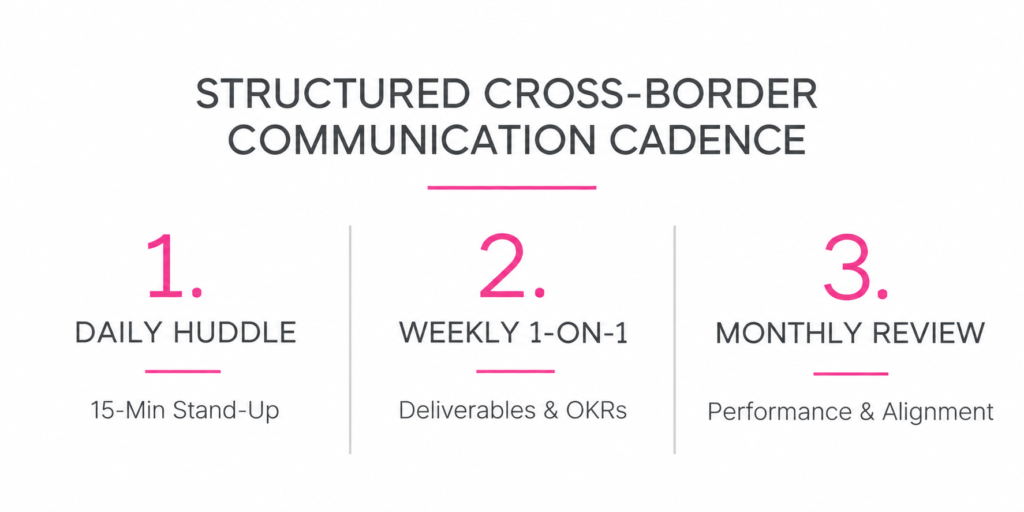
1. Synchronous vs Asynchronous Communication Cadence
- Daily 15-Minute Morning Stand-Ups: Host brief video catch-ups at 9:00 AM UK time (10:00 AM or 11:00 AM SAST) to review daily priorities, clear operational bottlenecks, and align deliverables.
- Asynchronous Project Tracking: Use centralized task management platforms like Asana, Jira, or Trello to document project status, assign sub-tasks, and attach documentation. This maintains workflow visibility without requiring constant status meetings.
- Real-Time Messaging Protocols: Utilize Slack or Microsoft Teams for rapid queries, reserving email for formal client communications or contractual instructions.
2. Standardized Tool Stack and Security Controls
Ensure all remote employees are provisioned with enterprise-grade cloud credentials before their start date. Require Multi-Factor Authentication (MFA), password management tools, and secure Virtual Private Networks (VPNs) to protect client data and comply with both UK GDPR and South Africa’s Protection of Personal Information Act (POPIA).
For detailed guidance on preparing IT infrastructure and data governance, review our step-by-step guide on How to Onboard a South African Remote Employee from the UK.
How do you set performance expectations, KPIs, and deliverables for remote hires?
Managing remote employees effectively requires replacing subjective oversight with objective performance metrics. Setting transparent Key Performance Indicators (KPIs) and Objectives and Key Results (OKRs) provides remote professionals with the clarity needed to execute independently.
1. Defining Clear Role Deliverables
- Quantifiable Outputs: Define role performance around specific deliverables (e.g., number of reconciliations completed, client tickets resolved, or marketing campaigns executed) rather than time spent at a desk.
- Standard Operating Procedures (SOPs): Document operational workflows and brand guidelines in a central knowledge base (such as Notion or Confluence) so remote staff can resolve procedural questions independently.
- Quality Benchmarks: Establish clear quality standards and review mechanisms early in the onboarding phase.
2. Managing Probation and Performance Reviews
Under South African labour legislation, probationary periods are recognized to evaluate a new employee’s operational fit. Contracts managed via an Employer of Record (EOR) typically specify a three- to six-month probation period. UK line managers should schedule bi-weekly performance reviews during probation to provide constructive feedback, identify upskilling needs, and ensure alignment with business goals.
Data from the RecruitMyMom Working Women in South Africa Report 2026 shows that 53.9% of skilled South African female professionals remain with a single employer for three years or longer when offered structured feedback, clear progression pathways, and supportive management. This long-term loyalty significantly exceeds the South African national average tenure of two years and ten months, providing UK SMEs with exceptional team stability.
To learn how to foster long-term retention and team alignment, read our guide on How to Build Company Culture Across UK and South African Remote Teams.
How do compliance, payroll, and local HR support strengthen management?
Line managers should focus on operational direction and team productivity rather than cross-border payroll mechanics or foreign employment law. Partnering with a registered recruitment and Employer of Record agency simplifies cross-border management.
| Management Dimension | Direct Employment Model | Independent Contractor Model | Employer of Record (EOR) Model |
| Legal Employer | UK Firm (Requires SA entity) | Self-employed professional | Registered SA EOR (RecruitMyMom) |
| Day-to-Day Line Management | UK Manager | Output / Deliverable Focused | UK Manager |
| Local Tax & Payroll Admin | UK firm runs SA payroll | Contractor manages own tax | EOR handles PAYE, UIF & SARS |
| Statutory HR & Leave Admin | UK firm manages directly | Not applicable | EOR manages statutory leave & HR |
| Worker Misclassification Risk | High if entity unregistered | Moderate to High for full-time set hours | Zero (Full legal compliance) |
Statutory Tax and Payroll Administration
Under both GOV.UK HMRC Guidance and the South African Revenue Service (SARS), individuals working exclusive hours under direct line management are classified as employees. An EOR structure eliminates worker misclassification risk by placing the employee on a compliant South African contract while remitting Pay-As-You-Earn (PAYE) and Unemployment Insurance Fund (UIF) contributions directly.
Legal Disclaimer: This article provides general commercial guidance and does not constitute formal legal, tax, or employment advice. Employers should consult qualified advisers regarding their specific international operational setup.
Practical Client Scenario: Scaling Operations Management for a UK E-Commerce Business
The Challenge: A rapidly growing Bristol-based e-commerce SME was experiencing severe operational bottlenecks in customer service management, inventory tracking, and supplier communications. Domestic recruitment efforts yielded high salary expectations (£45,000+ base salary plus 15% Employer National Insurance), while managing asynchronous freelancers in Asia resulted in missed client SLAs due to time-zone delays.
The Management Solution: The business engaged RecruitMyMom to hire South African talent from the UK, recruiting a full-time Senior Operations Coordinator in Cape Town. The hire was onboarded compliantly via RecruitMyMom’s Employer of Record (EOR) service.
The Management Structure:
- Synchronized Working Hours: The coordinator worked 8:00 AM to 5:00 PM SAST (7:00 AM to 4:00 PM BST), providing complete workday overlap with the Bristol management team.
- Clear Deliverable KPIs: The UK Operations Director established explicit daily targets around inventory reconciliation and supplier response times using Zendesk and Asana.
- Structured HR Administration: RecruitMyMom managed local SARS tax withholdings, statutory leave tracking, and payroll, leaving the UK director free to focus purely on daily line management.
The Commercial Outcome: Customer response times improved by 45% within the first month. The UK firm saved over £28,000 annually in comparative headcount costs while maintaining complete management oversight.
EDITORIAL NOTE: This is intentionally labelled as an illustrative scenario. Replace it with a verified RecruitMyMom UK client case study later if a client has approved the figures and facts for publication.
Optimize Your Remote Management Strategy with RecruitMyMom
Managing international remote talent effectively requires a trusted partner with deep recruitment expertise and compliant local infrastructure. Established in 2012, RecruitMyMom is an award-winning South African recruitment agency registered with the Department of Employment and Labour. Trusted by over 6,000 local and international employers and backed by a 4.9-star Google rating and a 75.8% 12-month candidate retention rate, RecruitMyMom provides direct access to an established network of 250,000+ vetted South African professionals across 250+ skill categories.
Whether you require permanent remote employees via Employer of Record (EOR), independent contractors, flexible Virtual Assistants, or fractional C-suite leadership, RecruitMyMom manages candidate sourcing, vetting, salary benchmarking, and compliance administration end-to-end.
Discover our flexible remote talent options on the [RecruitMyMom UK Remote Talent service page] or explore our dedicated [RecruitMyMom Employer of Record service page]. You can also Request a Recruitment Advisory Consultation to discuss your remote team management requirements with our specialists.
Frequently Asked Questions
How do UK managers track productivity when managing South African remote staff?
Productivity is best tracked using objective outcome metrics, clear KPI benchmarks, and project management software (such as Asana, Jira, or Trello) rather than intrusive screen-monitoring software. Daily 15-minute stand-ups and weekly 1-on-1 reviews provide complete visibility over deliverable progress.
What happens if a South African remote employee underperforms?
If performance concerns arise, the UK line manager provides structured feedback and documents deliverable gaps during regular check-ins. When employing staff through an Employer of Record (EOR), RecruitMyMom provides local HR guidance to ensure performance management procedures comply fully with the South African Labour Relations Act (LRA).
Do UK managers need to adjust working hours to manage South African staff?
No. South Africa operates on GMT+2, which is just one hour ahead of British Summer Time (BST) and two hours ahead of Greenwich Mean Time (GMT). South African professionals work normal daytime hours that overlap almost entirely with standard UK business hours.
How are public holidays and statutory leave managed for South African remote hires?
When employing staff via an Employer of Record (EOR), employees receive local South African statutory leave entitlements (including 21 consecutive days of annual leave and statutory public holidays) under the Basic Conditions of Employment Act (BCEA). Leave schedules can be coordinated with the UK manager to ensure continuous business coverage.